White walls and beige trim is one of those pairings that sounds simple on paper — and then you see it done right and it stops you in your tracks. Warm, grounded, and surprisingly versatile, this combination works in a cramped hallway just as well as it does in an open-plan living room. We’ve seen it refresh Victorian terrace houses and modernize new-build boxes alike. Done well, it’s not a safe choice — it’s a smart one. The white you put on the wall matters just as much as the beige you choose for the trim — and if you haven’t locked in your wall colour yet, it’s worth exploring the best off white paint colors before you commit to either.
Beige Trim White Walls: What This Pairing Actually Does to a Room

Most people think of beige as the background. Here, it’s doing real work. When you run beige trim against a white wall, you’re creating a visual boundary — a line that defines where the room begins and ends, frames your windows and doors, and pulls the eye downward toward the floor. The effect is structured without feeling rigid.
White walls tend to bounce light aggressively. A cool white, in particular, can feel sterile in rooms that don’t get enough natural light. Beige trim counteracts this by introducing warmth at the edges — exactly where the eye travels when it scans a room. It acts as a tonal anchor, preventing that “hospital corridor” effect that pure white interiors can drift toward.
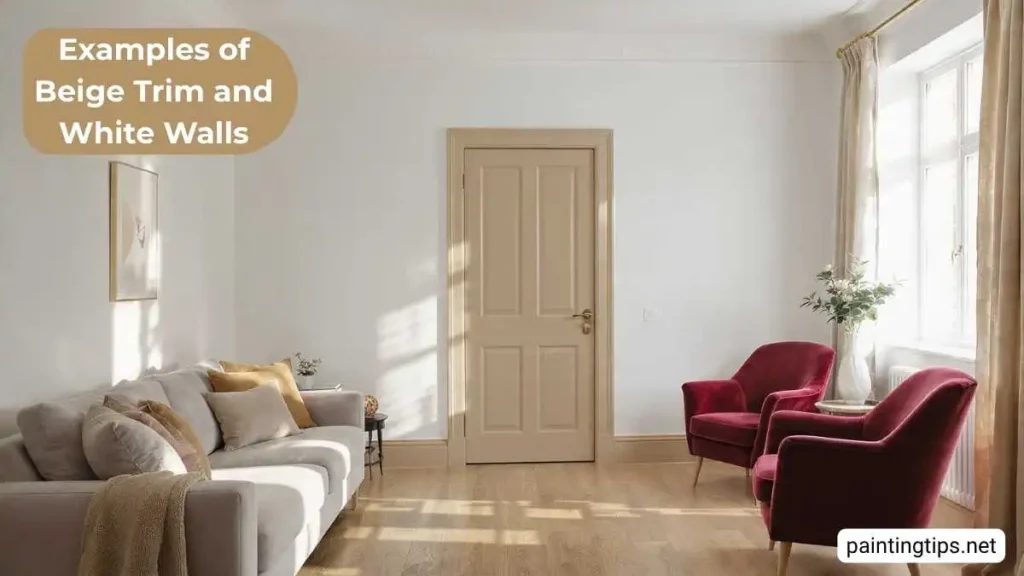
The other thing beige trim does — and this is underappreciated — is make white walls look whiter. The contrast between a warm trim and a clean wall amplifies the brightness of the wall itself without the need for a starker, harsher white.
Why Beige Trim Works Where Bright White Trim Can Fail
Bright white gloss trim on white walls can disappear entirely in low light, or worse, create a chalky, flat contrast in rooms with warm artificial lighting. Beige trim holds its own under both natural and incandescent light. It reads as intentional rather than accidental, and it doesn’t compete with the wall — it complements it.
We’ve also found that beige trim ages considerably better than white. White trim shows scuffs, yellowing, and handprints more readily. A warmer beige tone conceals everyday wear far more graciously, which matters in hallways, around door frames, and at skirting board level.
The Best Shades of Beige Trim for White Walls and How Each One Reads
Not all beige is the same, and the shade you choose will determine whether your room feels relaxed, elegant, or slightly off. Here’s how the main beige families perform against white walls:

- Warm Cream Beige: Shades like Benjamin Moore’s White Dove or Navajo White lean creamy and soft. Against a cool white wall, they read as clearly beige without being heavy. These work beautifully in period homes with ornate coving and architraves, where you want the trim to feel substantial but not dark.
- Sandy or Mid-Tone Beige: Farrow & Ball’s String sits comfortably here, and so does Sherwin-Williams Accessible Beige, a shade we’ve specified more times than we can count. It’s warm enough to read clearly against white but never tips into brown territory. Rooms with natural wood floors or linen-heavy furniture tend to suit this range particularly well.
- Greige (Grey-Beige): This is where beige trim on white walls gets genuinely contemporary. Greige tones like Agreeable Gray (Sherwin-Williams) or Elephant’s Breath (Farrow & Ball) are cooler, more restrained, and pair exceptionally well with cool-toned whites. They suit open-plan spaces, kitchens, and rooms with a more minimal, Scandinavian-influenced aesthetic.
- Deep or Tan Beige: Darker beige shades approaching a warm taupe make a bold statement against white walls and should be used with intention. They work best in rooms with high ceilings and generous natural light. In lower-ceilinged spaces, they can feel heavy.
The single most important rule across all four families: always check the undertone of your white wall and your beige trim in the same room under actual lighting conditions before committing. A warm, yellow-based beige trim will clash with a cool, blue-based white wall in ways that are hard to name but immediately visible.
Matching Your Floors with Beige Trim and White Walls
The floor is the third panel of this picture, and it has a significant say in how the combination lands.

Light oak or blonde wood floors are arguably the most natural partner for white walls and beige trim. The warm undertone in the wood echoes the warmth of the trim, while the paleness of the floor keeps the room airy.
Dark wood floors — walnut, dark stain oak — create a striking layered look: white walls on top, beige trim as the middle tone, and the deep floor anchoring everything. This works well in traditionally styled rooms or dining rooms where you want the space to feel rich and settled.
Grey or stone-effect floors, increasingly common in open-plan kitchens, call for a greige trim rather than a warm sandy beige. If the floor is cool-toned and the trim is warm, the two will fight each other.
Carpet in neutral tones — oatmeal, warm grey, pale stone — pairs without issue. Watch the undertone: a carpet with a pink undertone can make even a neutral beige trim look slightly orange under certain lighting.
Beige Trim on White Walls and Doors: Getting the Doors Right
The doors are where a lot of people hesitate, and understandably so. A door is a large flat surface — it’s a commitment. Here’s how to think about it.
Should Your Interior Doors Match the Beige Trim?
In most cases, yes. When doors and trim are painted the same colour, the room feels resolved. The eye reads it as a coherent system: window frames, door frames, skirting boards, and the door itself all speaking the same language.

Painting the door white while keeping the trim beige can work, but it requires care. The door needs to be a clean, crisp white not yellowed or off-white or the contrast will look accidental rather than deliberate. If the door has moulded panels, matching the trim colour is almost always the better call.
White Walls, Beige Trim, and Dark Interior Doors

One of the stronger current trends in this space is pairing white walls and beige trim with a dark-painted door — charcoal, deep navy, or even black. This creates a focal point that the room organises itself around, with the beige trim acting as a transition between the white wall and the dark door rather than a hard line. It’s a sophisticated look that works particularly well in hallways and dining rooms.
Curtains are where a lot of people undo a perfectly good wall-and-trim combination. Our guide to the best curtains for white walls is worth a read before you buy anything.
Where This Combination Works Best
- Hallways and Staircases: Hallways are the hardest-working area of any home. Beige trim here provides instant warmth and — practically speaking — handles scuffs better than white. Use a mid-sheen or satin finish on the trim in hallways over flat or matte; it wipes clean more easily and holds up to daily contact around door frames and banister areas.
- Kitchens: In kitchens, greige trim against white walls is an increasingly popular choice, particularly in shaker-style kitchens where the cabinetry and the trim are often the same colour. When cabinet colour, door colour, and skirting are unified in a warm greige against white walls, the kitchen reads as designed rather than assembled.
Mistakes to Avoid with Beige Trim on White Walls
- Choosing beige trim that’s too close to the wall colour: If your white leans cream, a very pale beige trim will blend in and the definition you’re looking for disappears. You need enough tonal separation for the trim to read as a deliberate feature.
- Ignoring the ceiling: In rooms with beige trim and white walls, a pure white ceiling is typically the right call — it keeps the space from feeling top-heavy. If the ceiling dips toward cream, the whole room can start to feel closed in.
- Finishing trim in flat paint: Trim should always carry a harder-wearing sheen than walls — satin or semi-gloss. Flat beige trim marks, fades, and scuffs faster, and loses its cleanness quickly in busy areas.
Does Beige Go with White Walls?
Absolutely beige and white are one of the most reliably successful pairings in interior design. The key is undertone alignment: warm whites pair best with sandy or creamy beige, while cool whites work better with greige tones. Get that right and the combination is nearly foolproof.
What Colors Go Well with Beige Trim?
Beige trim is one of the most accommodating trim colours you can choose. It sits comfortably alongside warm neutrals like camel, terracotta, and mustard, and works equally well with cooler accents like navy, forest green, and dusty blue. Natural materials — linen, raw wood, jute — are particularly at home in rooms with beige trim.
What Trim Color Looks Best with White Walls?
It depends on the effect you’re after. Crisp white trim creates a seamless, airy look but demands precise undertone matching. Beige or greige trim introduces warmth and definition, which suits traditional homes, period features, and spaces that rely on artificial lighting. Black or dark trim is the high-contrast choice for contemporary interiors. For most homes particularly those with warm-toned floors or natural materials beige trim is the most forgiving and the most flattering.
Should Trim Be Darker or Lighter Than Walls?
Traditional convention says trim should be lighter or the same value as the walls. With white walls, beige trim sits in a grey zone: it’s a different hue, but not necessarily darker in value. What matters more is contrast and intention. Beige trim against white walls creates gentle, warm contrast that frames the room without imposing on it. If you want stronger drama, go darker. If you want seamless flow, stay closer to the wall colour in tone.
