Gray Owl is one of Benjamin Moore’s most consistently searched paint colors—and once you see it on a wall, the appeal is clear. It’s a true light gray without the green or purple shift that makes many grays difficult to work with, and it holds up across different lighting conditions better than most colors in its range. This review covers how Gray Owl actually performs in living rooms, bathrooms, bedrooms, entryways, and kitchen cabinets along with its undertones, coordinating colors, and whether it’s the right choice for your space.
Benjamin Moore Gray Owl
Benjamin Moore Gray Owl (OC-52) is a light, cool-toned gray that sits firmly in the gray category without pulling toward beige or greige. Its LRV of approximately 65 places it in the upper-medium light range—bright enough to keep rooms feeling open and airy, but with enough depth to read as a deliberate color choice rather than an almost-white. In strong natural light it reads as a clean, fresh gray. In lower light or under artificial lighting, it can shift slightly toward blue or blue-green, which is worth factoring in depending on the room.
What makes Gray Owl particularly workable is its consistency. Many light grays are chameleons that shift dramatically between morning and evening or between north- and south-facing rooms. Gray Owl moves, but within a predictable range—you’re not going to paint a room and discover it looks entirely different from what you expected.
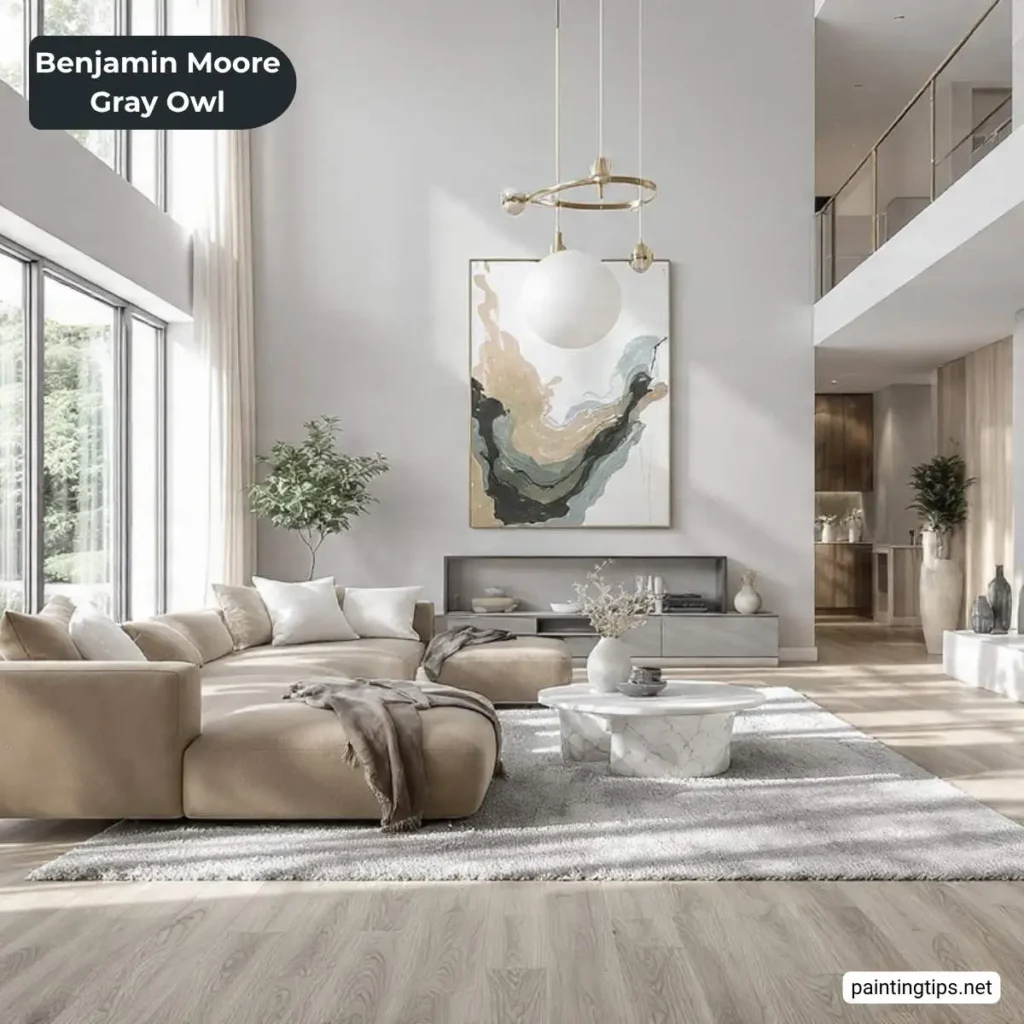
For flooring, warm wood tones in mid-range oak and walnut sit naturally against Gray Owl’s cool gray, creating a warm-cool balance that keeps the room from feeling cold. Light or blonde wood can feel slightly clinical alongside it; dark walnut provides strong contrast that works particularly well in modern interiors.
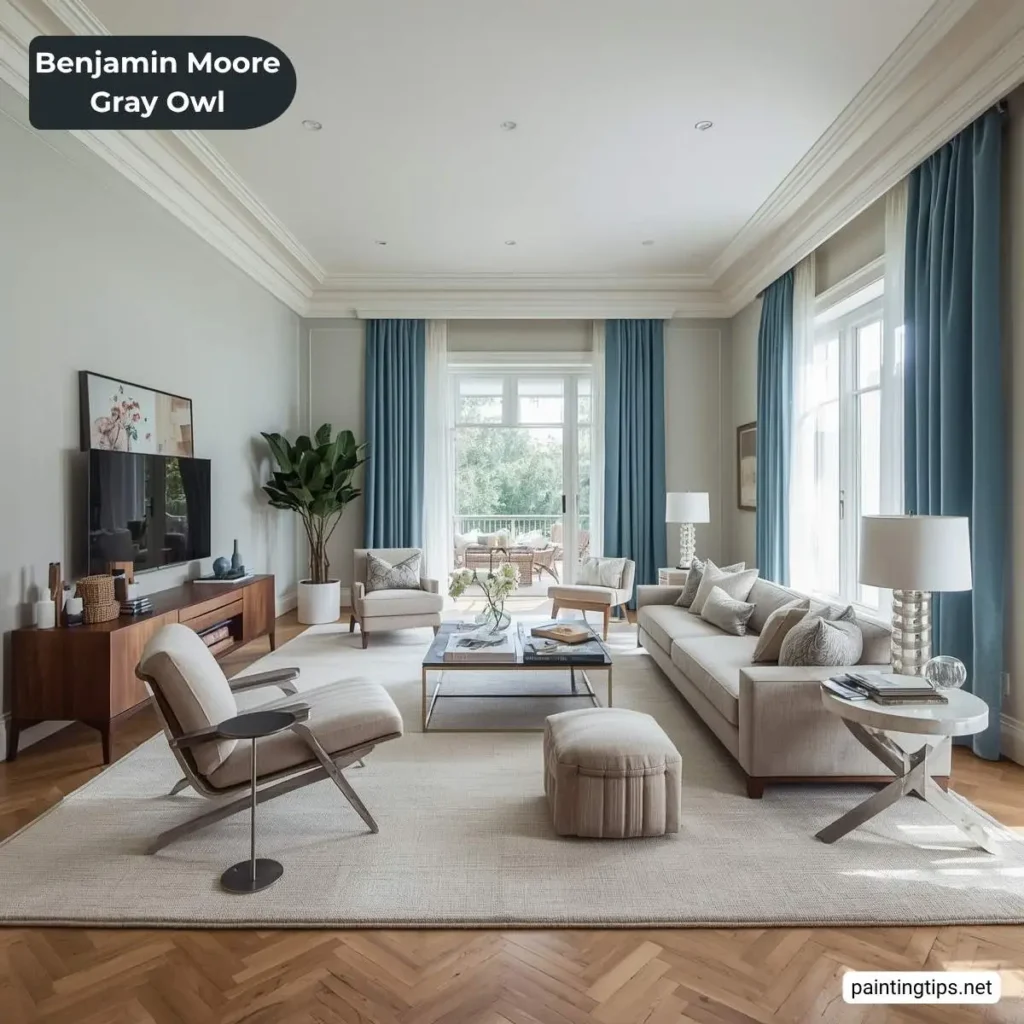
For furniture, both warm and cool tones work—warm whites and creams, charcoal, navy, and natural linen all sit comfortably against Gray Owl walls. Warm wood furniture adds the warmth the color itself doesn’t supply. Avoid furniture in a very similar cool gray to the walls, which tends to disappear into the background.
For curtains and soft furnishings, warm white linen is the most natural choice and keeps the room feeling light. For a more deliberate look, navy, charcoal, soft teal, or dusty blue work well as accent colors through cushions, throws, and window treatments.
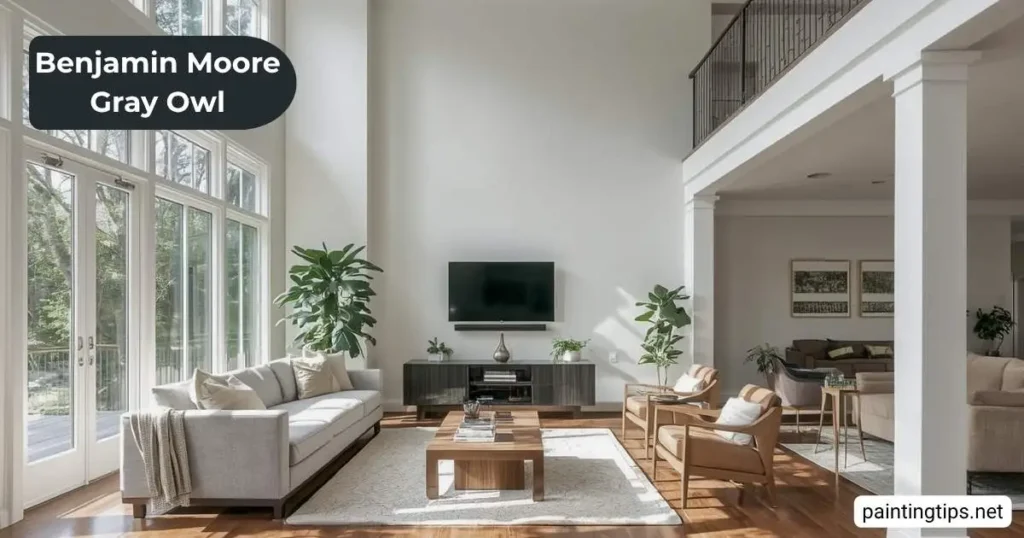
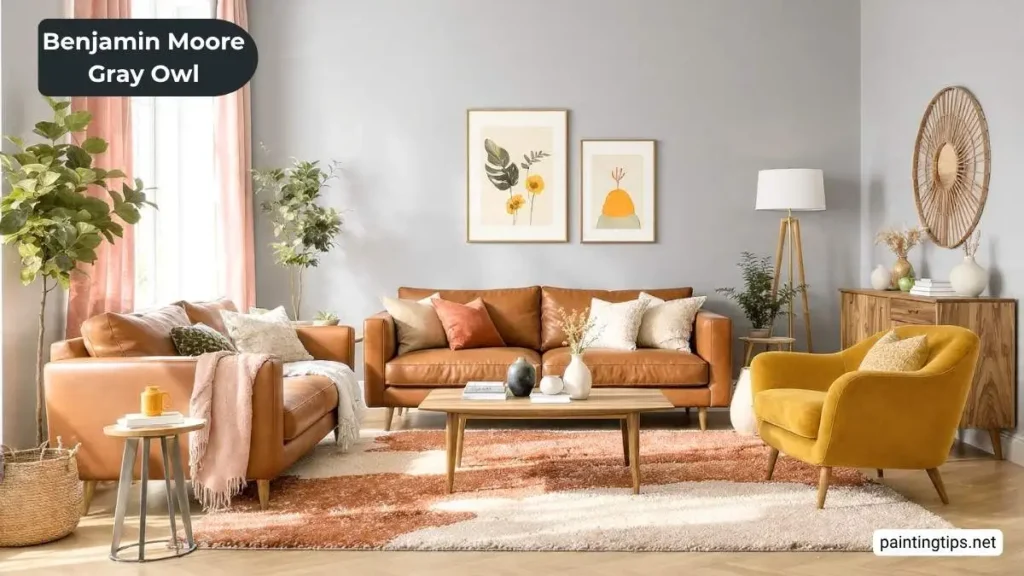
For rugs, warm-toned options—camel, terracotta, warm beige, or a Persian-style rug with warm tones—counteract the color’s cool quality and give the room warmth it doesn’t generate on its own. A charcoal or navy rug creates a graphic, contemporary look that suits modern interiors particularly well.
Benjamin Moore Gray Owl Living Room
In a living room, Gray Owl reads as a sophisticated, calm backdrop that works well across a range of furniture styles—from contemporary to transitional. Its cool quality prevents it from feeling heavy or dated, and its LRV of 65 keeps the room feeling open even in larger spaces with less natural light. If you want more furniture color ideas for gray walls beyond these classic options, check out our complete guide to the best furniture colors for gray walls and different room styles.
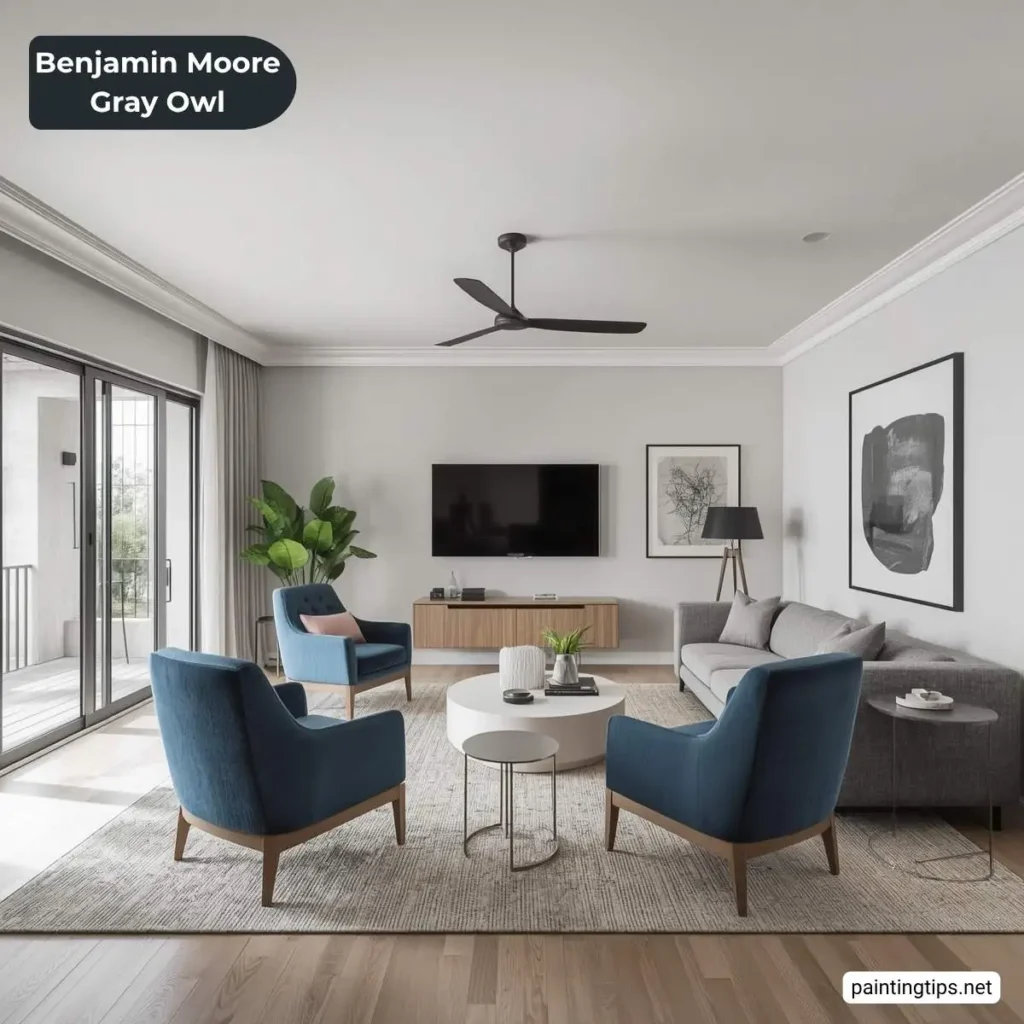
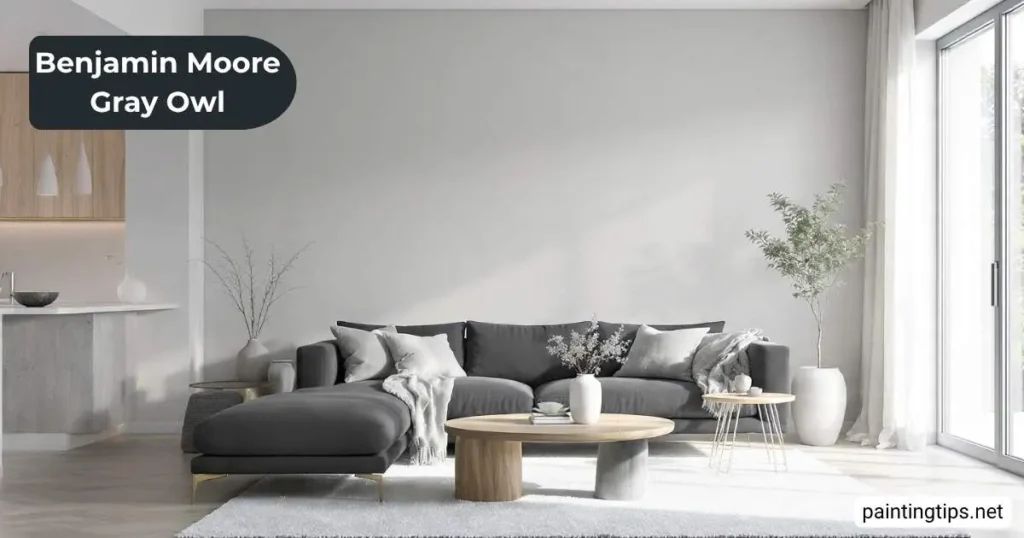
The main consideration in a living room is warmth. Gray Owl on every wall without warm counterbalancing elements—wood tones, textured textiles, warm metallics—can feel sterile. A warm-toned rug is often the single most effective fix: it covers a large surface area and shifts the overall feel of the room considerably. Warm brass or gold light fixtures and hardware add richness without introducing color conflict. For a more detailed look at matching rugs with gray interiors, our guide on how to pick a rug color for living room explains the best color combinations for every style and layout.
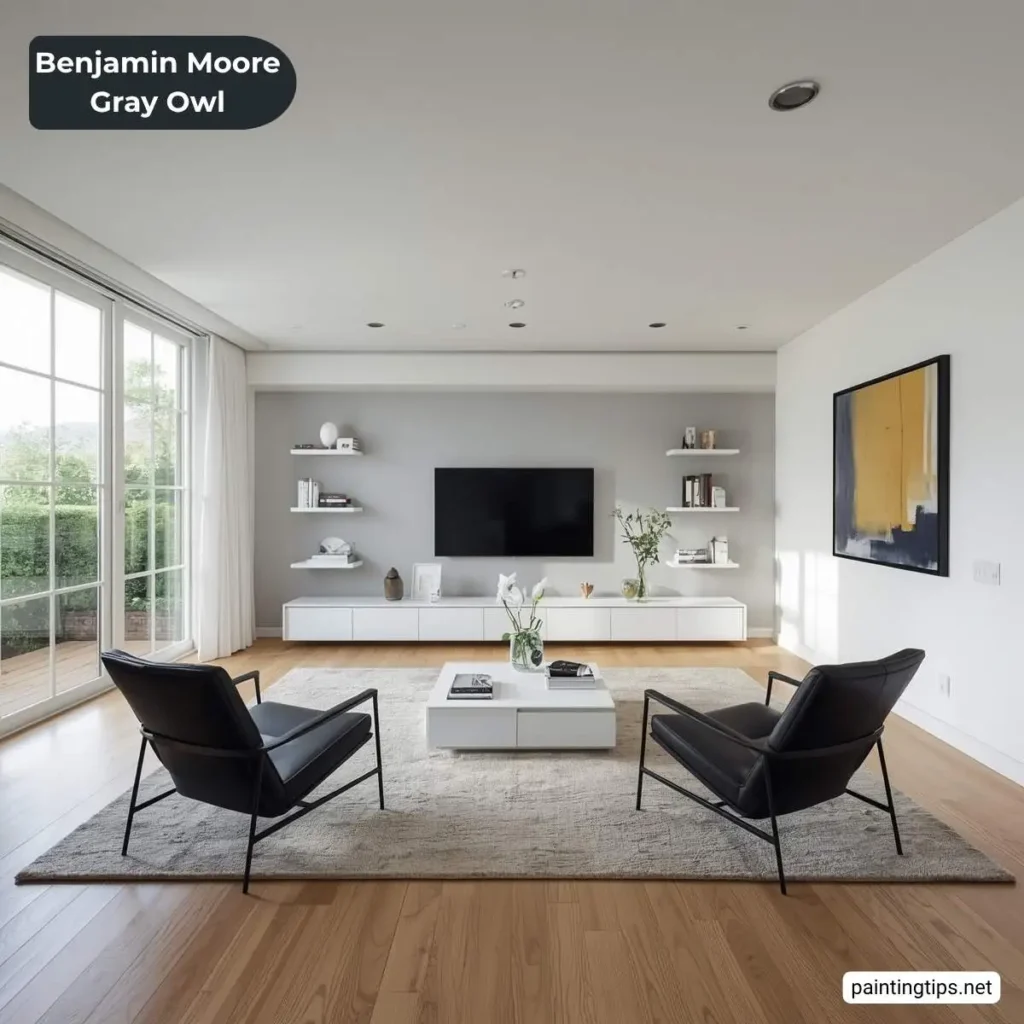
Gray Owl works well with white trim throughout a living room. Benjamin Moore’s White Dove (OC-17) is the most commonly paired trim color—it’s warm enough to complement Gray Owl’s cool quality without clashing. Simply White provides slightly crisper contrast and works well in rooms with strong natural light.
Benjamin Moore Gray Owl Bathroom
In a bathroom, Gray Owl performs reliably but with one caveat: bathroom lighting can push its blue-green undertones forward more than in other rooms. Cool overhead LEDs are particularly likely to shift the color in this direction. Switching to warm-toned bulbs—2700K to 3000K—usually brings it back to its intended light gray quality and makes a significant difference in how the color reads.
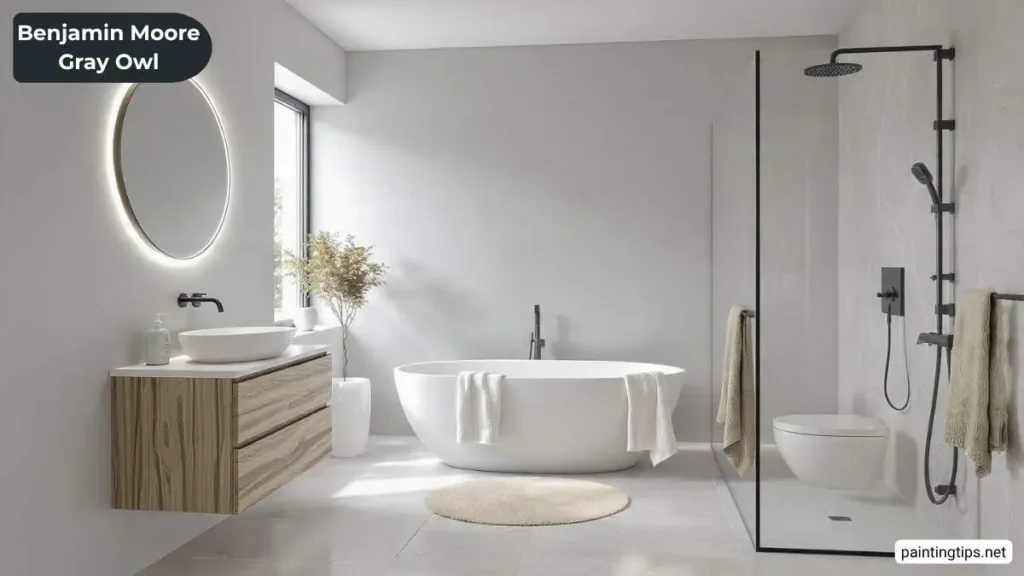
White fixtures and chrome hardware work well alongside Gray Owl. Brushed nickel and matte black also suit it naturally. Warm wood vanities—particularly in oak or walnut—add warmth that prevents the bathroom from feeling clinical.
In smaller bathrooms, the LRV of 65 is generous enough to keep the space feeling open. Gray Owl won’t make a small bathroom feel claustrophobic the way a mid- or dark-tone gray would. In larger master bathrooms, it creates a clean, spa-like atmosphere when combined with natural stone, white tile, and layered warm lighting. “For broader inspiration on styling a gray bathroom beyond paint color, our guide on gray bathroom decor ideas is worth exploring.”
Benjamin Moore Gray Owl Bedroom
Gray Owl is one of the stronger choices available for a bedroom. Its cool, calm quality suits a sleeping space well, and its LRV keeps the room from feeling too heavy or enclosed even in rooms that rely on artificial light in the evening.
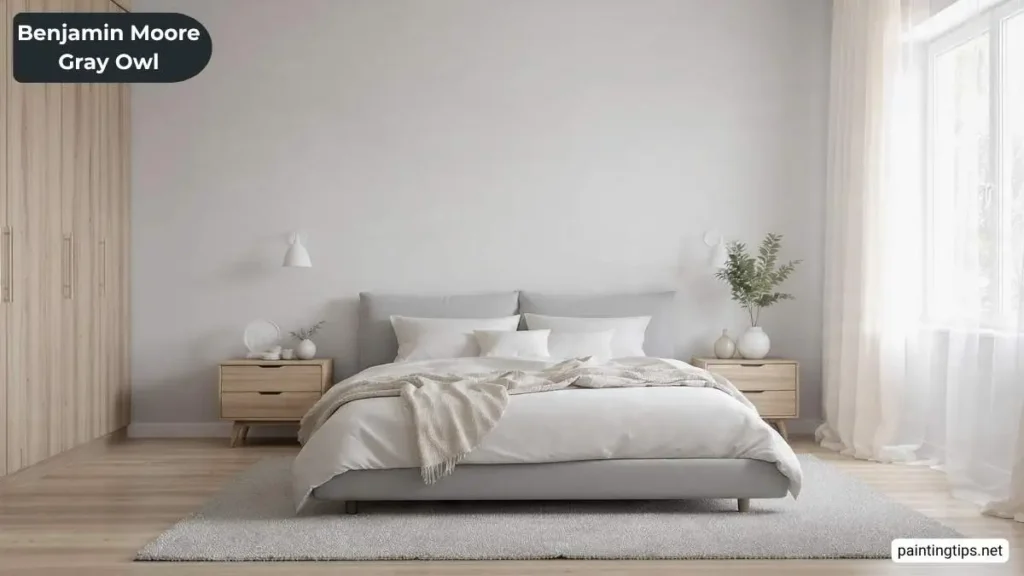
The color’s behavior under different lighting works in its favor in a bedroom specifically. Under daylight it reads as a fresh, airy gray. Under warm bedside lighting in the evening it shifts slightly warmer and creates an enveloping, restful atmosphere. That transition across the day actually suits a bedroom’s changing function—bright and awake in the morning, calm and comfortable at night.
For bedding, white and cream create a clean, hotel-like look against Gray Owl walls. Warm tones in dusty rose, camel, or soft mustard add warmth. Warm wood bed frames and nightstands sit most naturally against it and prevent the room from feeling too cool. Avoid very dark gray or blue-gray furniture against Gray Owl walls in a bedroom—the cool-on-cool combination amplifies the room’s cool quality in a space where warmth is usually the priority.
Benjamin Moore Gray Owl Entryway
An entryway painted in Gray Owl makes a clean, considered first impression without overwhelming a typically compact transitional space. Its LRV of 65 keeps the entry feeling open, and its cool neutrality means it transitions naturally into adjacent rooms painted in similar cool neutrals or crisp whites.
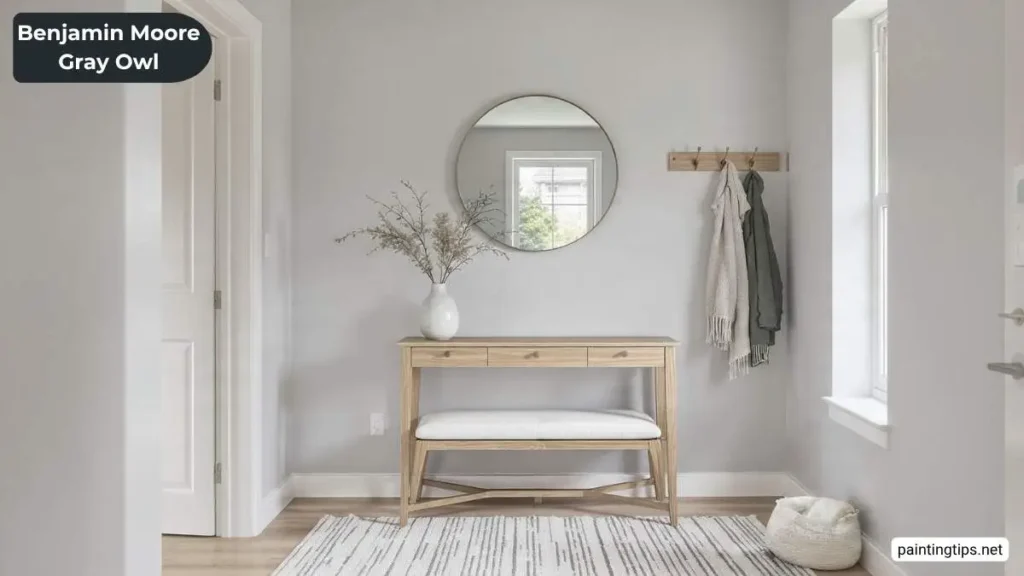
White trim in an entryway—door casings, baseboards, crown molding where present—reads clearly and crisply against Gray Owl, which makes the architectural details of the entry feel deliberate. Warm wood flooring and a warm-toned entry rug or runner add the warmth that Gray Owl doesn’t provide on its own. In a narrow or windowless entryway, warm-toned light fixtures are particularly important—cool overhead lighting will push the color toward blue and make the space feel colder than it needs to. For more ideas and real examples, our guide on gray interior walls with white trim explains which shades and combinations work best throughout the home.
Benjamin Moore Gray Owl Undertones
Gray Owl’s undertones are where it differs from many other popular light grays. It leans cool—specifically toward blue and occasionally blue-green—rather than the warm beige or greige undertones that characterize colors like Repose Gray or Agreeable Gray. This cool base is what gives it its clean, crisp character and prevents it from reading as a warm neutral.
In warm incandescent or soft white lighting, the blue undertone softens considerably and Gray Owl reads closer to a neutral gray. In cool LED lighting or in north-facing rooms with indirect natural light, the blue-green quality becomes more pronounced. Testing a sample in the actual room under actual lighting conditions—not just in the store—is essential before committing. What reads as clean gray in a showroom can read noticeably blue in a north-facing bedroom under cool overhead lighting.
One important clarification: Gray Owl is not a warm gray. If you’re looking for something with beige or greige undertones, Gray Owl will likely feel too cool. It’s a true cool gray—that’s its strength and its occasional limitation depending on the room.
Benjamin Moore Gray Owl Complementary Colors
Gray Owl’s cool base means it pairs most naturally with other cool tones and with warm accents that provide contrast and balance. The most effective complementary colors are:
- Navy blue is the strongest complementary color for Gray Owl—they share a cool tonal family and the contrast between them creates a room with real visual interest. Navy through cushions, accent furniture, or a feature wall reads particularly well against Gray Owl walls.
- Warm white and cream soften the coolness of Gray Owl and make rooms feel more approachable and livable. As trim colors, accent furnishings, or bedding, warm whites do more to counteract Gray Owl’s cool quality than any other single addition.
- Charcoal and deep gray provide tonal contrast that works well in contemporary interiors where a graphic, layered look is the goal. A charcoal sofa or charcoal rug against Gray Owl walls creates a cohesive cool palette with clear depth. “If you’re drawn to a darker, more dramatic direction, our guide on black and gray living room ideas shows how to take the palette further.”
- Warm terracotta and rust are the most effective warm counterpoints to Gray Owl—they sit opposite it on the color temperature spectrum and create the kind of warm-cool balance that prevents the room from feeling cold. Even small amounts through cushions or a rug make a noticeable difference.
- Warm wood tones in oak, walnut, and similar mid-range timbers add organic warmth that complements Gray Owl’s cool quality without introducing competing color.
Benjamin Moore Gray Owl Coordinating Colors
Benjamin Moore’s suggested coordinating colors for Gray Owl reflect its cool, clean character. The most useful pairings in practice are:
- White Dove (OC-17) is the most widely recommended trim color for Gray Owl—a warm white that softens the contrast between wall and trim and prevents the combination from feeling stark. It’s the trim choice that makes Gray Owl rooms feel refined rather than clinical. “White Dove is worth understanding in depth before you commit to it as a trim color—our guide on Benjamin Moore White Dove covers its undertones and how it performs in different rooms.”
- Simply White provides slightly crisper contrast and works well in rooms with strong natural light where a cleaner white reads better than the softer warmth of White Dove.
- Hale Navy (HC-154) is the standard deep accent color in the Gray Owl palette—a rich, classic navy that pairs naturally with Gray Owl’s cool base and creates a sophisticated, layered color scheme.
- Stonington Gray (HC-170) is a deeper, more saturated gray in the same cool family—useful for adjacent rooms where you want a cohesive whole-home palette with more depth than Gray Owl provides.
- Pale Oak (OC-20) is occasionally used as a warmer coordinating option for rooms adjacent to Gray Owl spaces where warmth is needed—its warm greige quality bridges the gap between Gray Owl’s cool character and warmer wood tones in the space.
Benjamin Moore Gray Owl Kitchen Cabinets
Gray Owl on kitchen cabinets has become an increasingly popular choice, and it performs well in this application for several reasons. On a cabinet finish—typically semi-gloss or satin—its cool undertones read more consistently than on walls, and the slightly elevated sheen of a cabinet finish keeps the color from looking flat or washed out. “If you’re unsure which finish to use on cabinets or walls, our guide on types of paint sheens explains the differences and when to use each.”
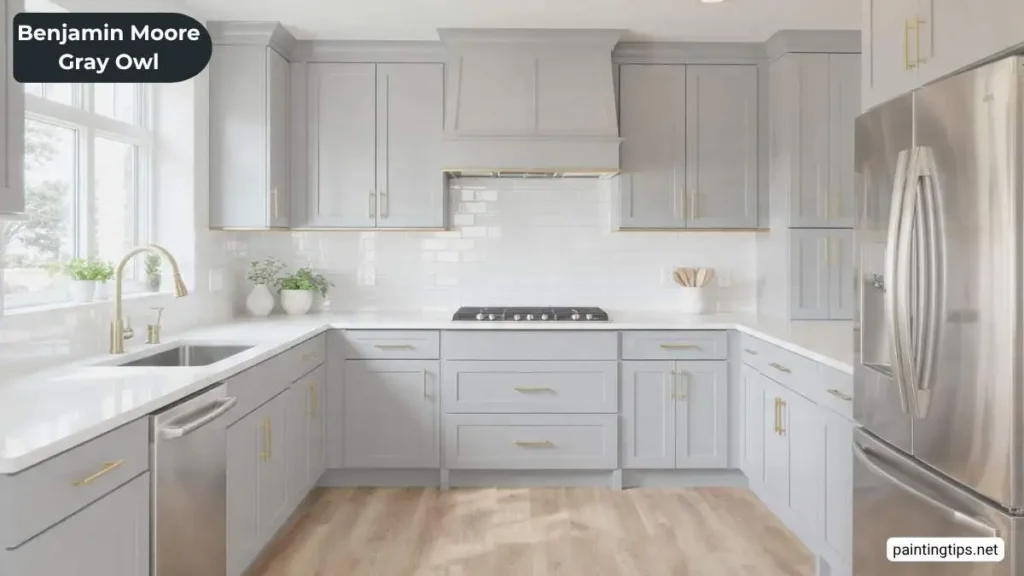
Against white walls, Gray Owl cabinets create a clean, contemporary kitchen with a clear tonal separation between walls and cabinets. Against gray walls in a similar tone, the contrast is reduced and the effect is more tonal and layered—worth considering if you want a cohesive look rather than strong contrast.
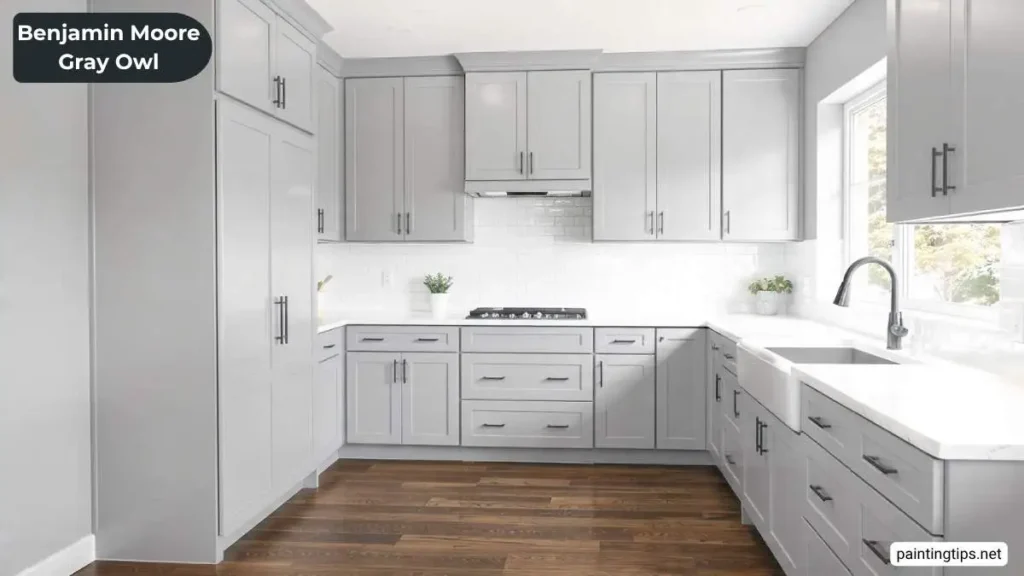
Hardware choice matters significantly with Gray Owl cabinets. Brushed brass and warm gold create a warm-cool contrast that’s become one of the most popular combinations in contemporary kitchen design. Matte black hardware creates a stronger, more graphic contrast. Chrome and brushed nickel suit the cool tone but don’t add the warmth that brass brings.
Benjamin Moore Gray Owl Number
Benjamin Moore Gray Owl is identified by two color codes depending on the collection: OC-52 — the primary identifier within Benjamin Moore’s Off-White collection, which is the most commonly referenced code. 2137-60 — the alternate code from Benjamin Moore’s historical numbering system. Both codes refer to the same color. If you’re ordering at a paint store or searching online, OC-52 is the more reliable code to use. Some retailers may not carry the 2137-60 designation, but OC-52 is consistent across Benjamin Moore’s full retail network.
Benjamin Moore Gray Owl Equivalent in Sherwin-Williams and Behr
Exact cross-brand matches for any paint color don’t truly exist—each company’s formulations, bases, and pigment systems differ enough that a “match” is always an approximation. That said, if you’re looking for a similar cool light gray in Sherwin-Williams or Behr, there are a few colors worth sampling alongside Gray Owl before deciding.
In Sherwin-Williams, Rhinestone (SW 7661) and Passive (SW 7064) are most frequently cited as close alternatives. Both sit in the same cool light gray range, though Rhinestone leans slightly cooler and Passive has a touch more warmth. Neither is an exact match—if you’re committed to Gray Owl’s specific quality, Benjamin Moore is the only source for it.
In Behr, French Silver (N520-2) and Silver Drop (790C-2) occupy similar territory. Both are cool, light grays with comparable LRV ranges, though the undertone balance differs subtly from Gray Owl.
The most reliable approach is to pull sample chips or painted samples of the alternatives and compare them directly against Gray Owl in your actual room under your actual lighting. A color that looks nearly identical on a chip can read differently on a wall at scale.
Benjamin Moore Gray Owl Reviews
Gray Owl earns its popularity for straightforward reasons: it does what a light gray is supposed to do without the complications that derail many light grays. It reads as a true gray across a wider range of lighting conditions than most comparable colors, its LRV keeps rooms feeling open without washing out, and it pairs naturally with both warm and cool furniture tones without demanding undertone-matching the way warmer grays do.
The limitation worth knowing going in is the cool undertone. In north-facing rooms, bathrooms with cool overhead lighting, or any space that relies heavily on artificial light, Gray Owl can shift noticeably toward blue or blue-green. Warm-toned lighting addresses this directly, but it’s a variable to account for before you commit. If your room runs cool and you want a gray that stays neutral, a slightly warmer option—Repose Gray, Agreeable Gray, or Revere Pewter—may serve you better.
For rooms with good natural light, a warm-lighting scheme, or a design that already incorporates warm wood tones and textiles, Gray Owl is one of the most reliable light grays available. The reviews from homeowners who’ve used it consistently point to the same qualities: it looks exactly like a gray should look, it works with most things around it, and it doesn’t do anything unexpected after the paint dries.
