A stray paint drip on a hardwood floor has a way of showing up right after we’ve admired our freshly painted walls, and most splatters can be lifted without sending the floor off for a full refinish. Below, we cover how to identify the paint type, five tested methods for getting dried paint off hardwood floors, how the type of floor changes what’s safe to use, and answers to the most common questions about cleaning hardwood floors.
How Do You Get Paint Off of Hardwood Floors
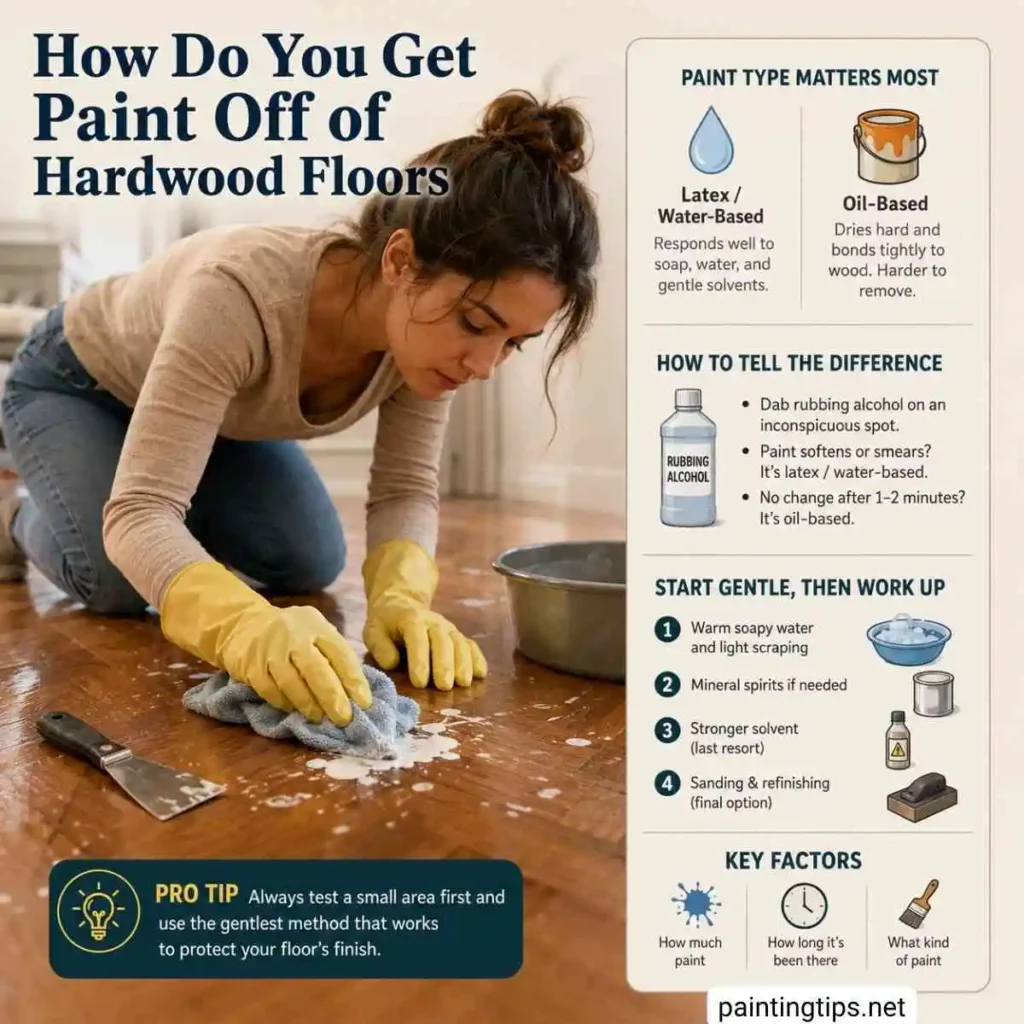
Before reaching for any tool or solvent, we always size up exactly what we’re dealing with. Three things determine how easy or difficult the job will be: how much paint is on the floor, how long it has been sitting there, and what kind of paint it is. In our experience, a fresh dime-sized splatter comes up in seconds with a damp cloth, while a decades-old drip that has bonded to the wood grain may need several rounds of softening and scraping.
Paint type matters the most out of these three factors. Latex and other water-based paints stay relatively soft even after they cure, so they respond well to soap, water, and gentle solvents. Synthetic, oil-based paints are a different story.
Once fully cured, oil-based paints form a hard, plastic-like shell that grips the wood fibers tightly, which makes them noticeably more permanent and considerably harder to remove without also lifting the floor’s finish. Anyone trying to get paint off the wood floor should identify the paint type first, since using the wrong approach on oil-based paint often wastes time or, worse, damages the floor.
A simple way to tell the two apart is to dab a small amount of rubbing alcohol on an inconspicuous edge of the stain. If the paint softens or smears, it is almost certainly latex or another water-based product. If nothing happens after a minute or two, the paint is oil-based and will need a stronger solvent to break down. If that same splatter reached the carpet nearby, how to get latex paint out of carpet walks through a very similar softening process.
Hot soapy water and gentle scraping work specifically on latex and other water-based paints. Every other method below applies to both water-based and oil-based paint, though oil-based stains typically need more time, more passes, or a stronger solvent before they let go.
We recommend the same order most experienced painters and refinishers follow: start with the gentlest option and only move on to something stronger if the paint doesn’t budge. That means beginning with warm soapy water and light scraping, moving on to mineral spirits if needed, reaching for a stronger solvent only as a last resort, and treating full sanding and refinishing as the final option when a spot simply won’t come clean any other way.
1-Warm Water and Soapy Water with a Spatula
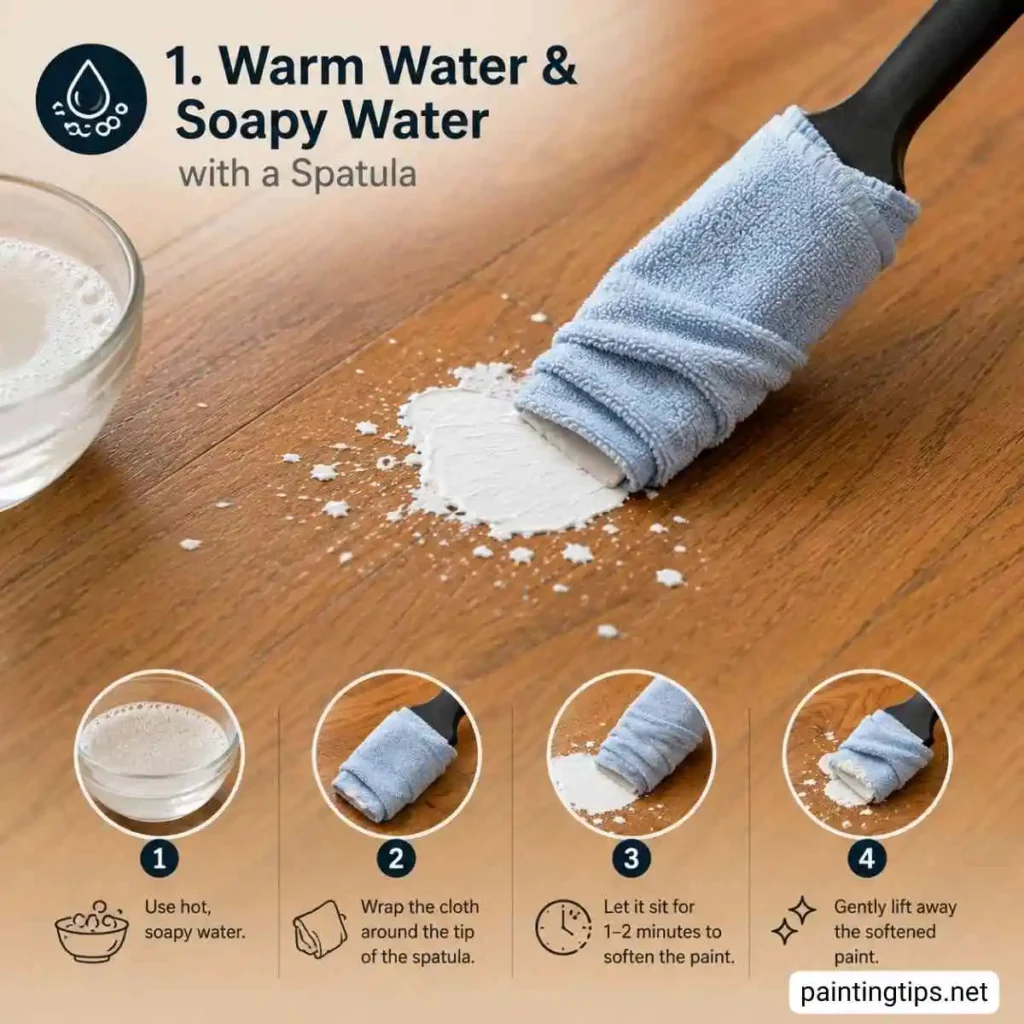
This is where we start with almost any paint spot on wood floors, and it’s one of the most commonly recommended methods overall. Soaking the tip of a cloth in hot water and wrapping it around a spatula, ideally a plastic one, softens the paint before any scraping begins.
Working the wrapped spatula gently under the edge of the paint lifts it away with far less risk to the finish than dry scraping, since the heat and moisture do most of the work and there is rarely a need to press hard or force the blade underneath the paint.
If plain hot water isn’t cutting through the paint, we add a few drops of dish soap like Dawn, or a splash of Murphy’s Oil Soap, to the water. Letting the soapy water sit on the paint for a minute or two softens it further, after which the flat spatula lifts it away cleanly.
We’ve found this two-step approach alone is often enough to clear latex paint off hardwood floors without needing anything stronger, so it’s worth spending real time here before moving to solvents, since every method after this one carries a bit more risk to the floor’s finish. A drip on the sleeve while working through the same spot is common too, and removing water based paint from clothes covers the same soap-and-water logic.
2-Mineral Spirits
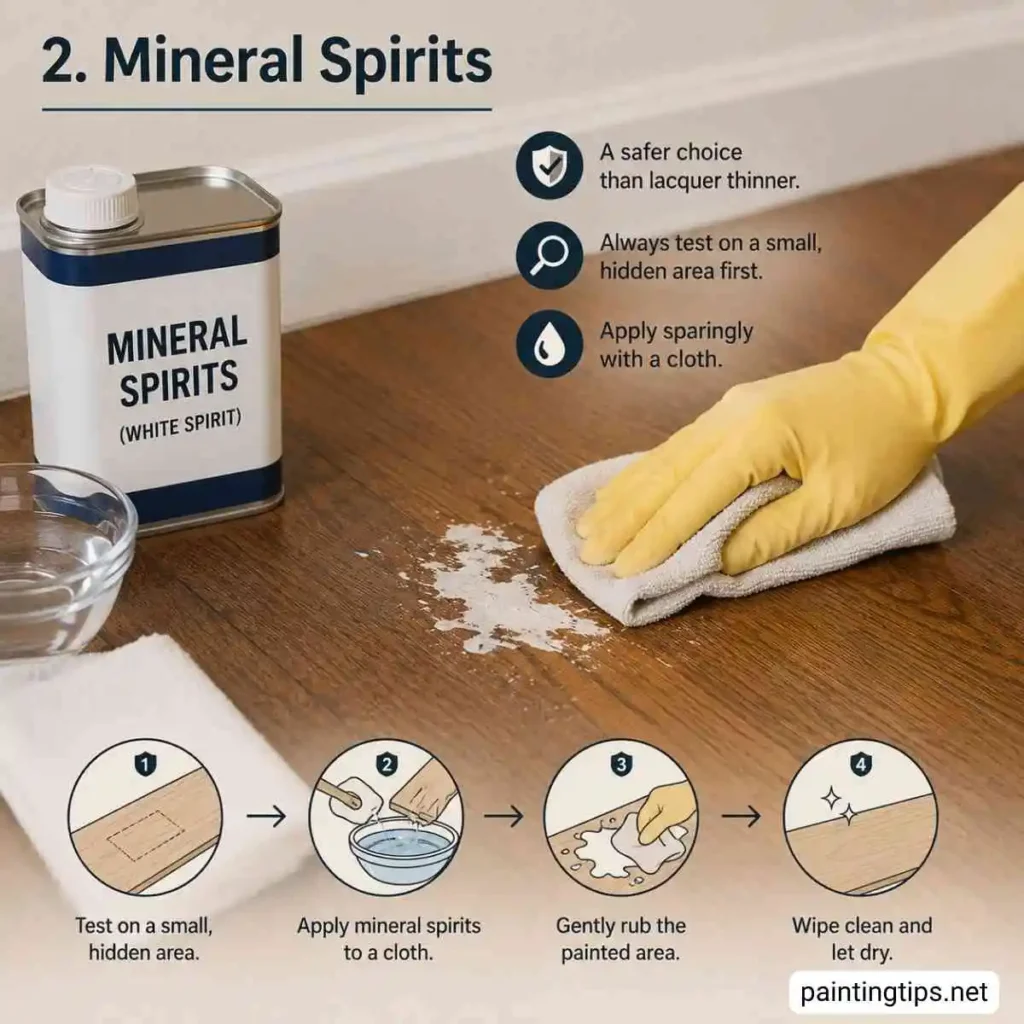
For paint that has fully dried and resists soap and water, we reach for mineral spirits (also sold as white spirit) as the next step up. We consider it a safer choice than lacquer thinner, since it is far less likely to strip the floor’s finish along with the paint.
We always test on a small, hidden section of the floor first before treating a visible spot. Applying it sparingly with a cloth, rather than pouring it directly onto the wood, keeps the risk to the surrounding finish to a minimum.
3-Paint Thinner
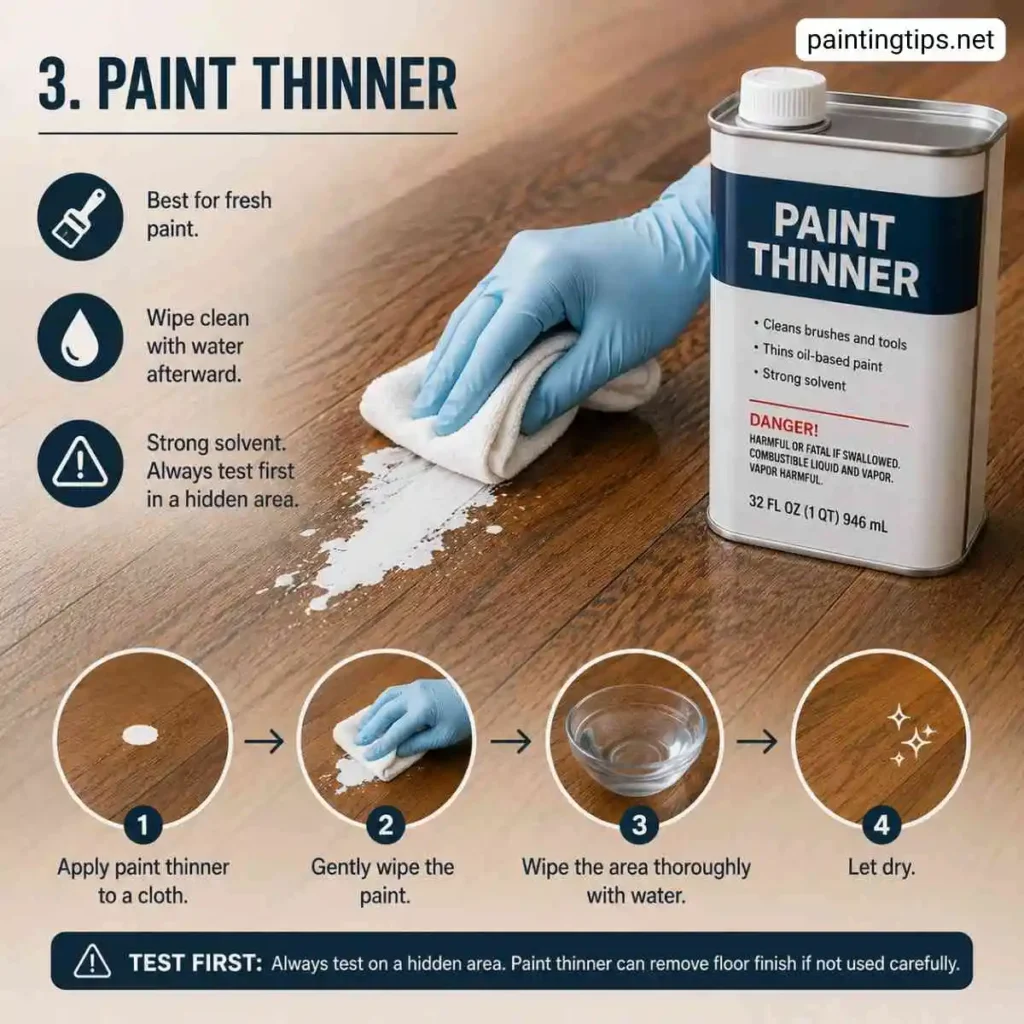
Paint thinner comes into play mainly for paint that is still relatively fresh, applied with a cloth rather than soaked into the floor. Once the paint lifts, the area needs a thorough wipe-down with water to clear any leftover residue.
In our experience, paint thinner is stronger than mineral spirits and can strip the floor’s varnish along with the paint if it isn’t handled carefully. Testing it in an inconspicuous spot first is non-negotiable, since a mistake here is much harder to undo than a leftover paint spot.
4-Heat Gun
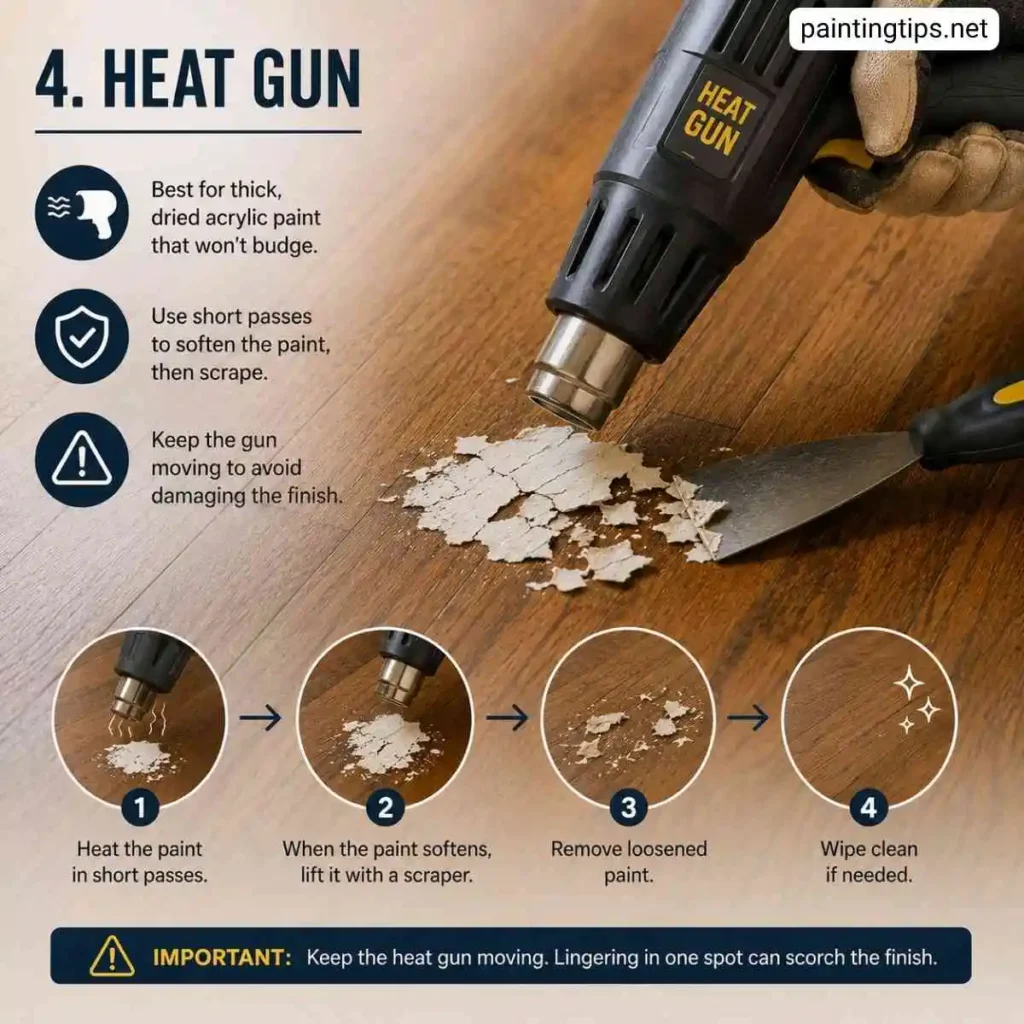
We reserve a heat gun for a thick layer of dried acrylic paint that hasn’t responded to solvents or soapy water. Working the heat gun in short passes rather than holding it over one spot softens the paint enough to lift with a scraper.
Constant movement matters more than heat level here. Lingering too long in one place risks scorching the finish underneath, which turns a paint problem into a much bigger repair.
5-Full Sanding and Refinishing
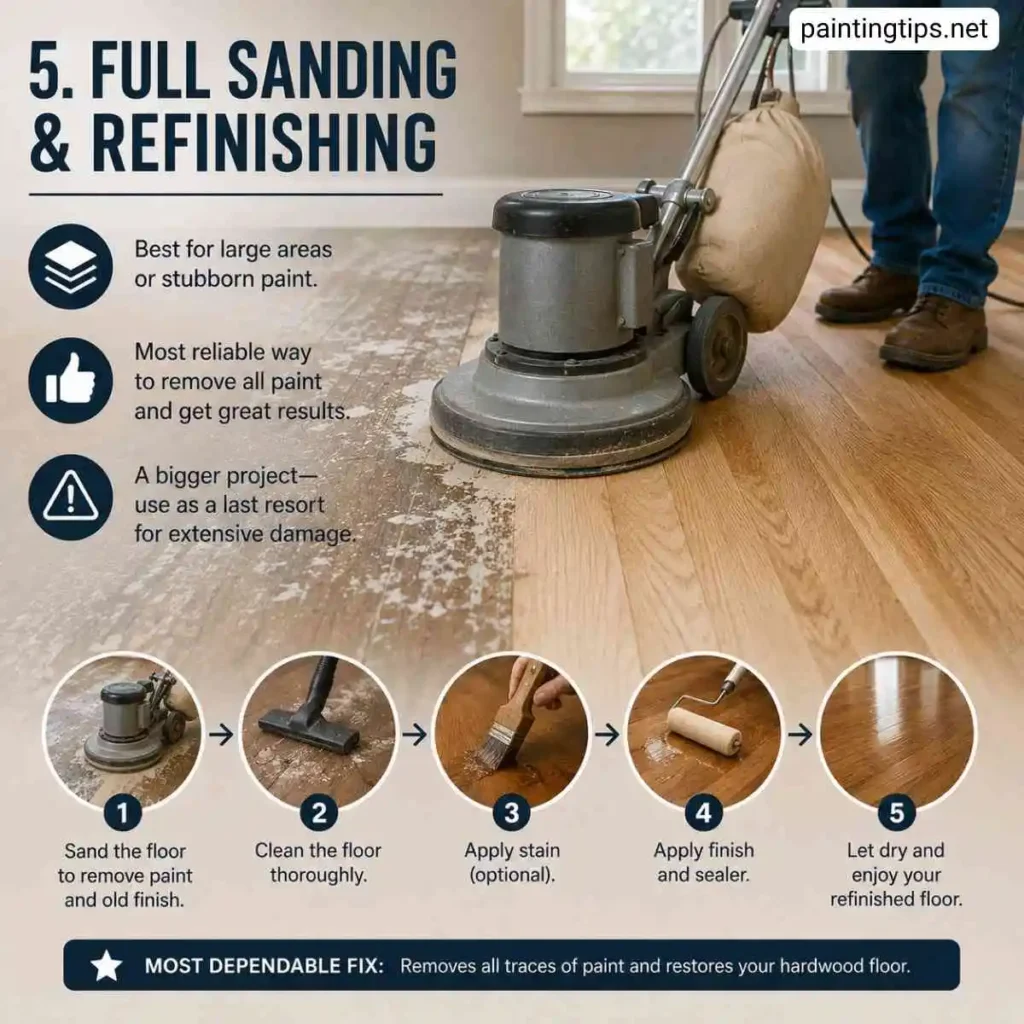
When paint covers a large area, or several methods above have already been tried without full success, we consider sanding the floor down and refinishing it the most reliable fix. It’s also the option that tends to leave homeowners the most satisfied with the outcome, since it clears every trace of old paint rather than leaving faint shadows behind.
It is a bigger project than spot treatment, so we treat it as a last resort rather than a first move, but it remains the most dependable way to clean paint off hardwood floors when the damage is extensive.
Will Rubbing Alcohol Damage Hardwood Floors?
Used correctly, we consider rubbing alcohol one of the safer solvents for hardwood floors, though it isn’t entirely risk-free. Light dabbing on a cloth, followed by prompt wiping and drying, rarely affects a well-sealed finish.
Problems tend to show up when alcohol is poured directly onto the wood or left to sit for extended periods, which can dull or cloud certain finishes, particularly older shellac or wax coatings. Testing on a hidden spot first remains the safest way to confirm how a specific floor will react.
Does WD-40 Remove Paint From The Floor?
WD-40 can loosen some types of dried paint thanks to its solvent properties, and it is sometimes used as a lubricant to help a scraper glide more easily under a paint edge. That said, it isn’t formulated as a paint remover, and it leaves an oily residue that needs thorough cleaning afterward.
It isn’t the first choice among flooring professionals when purpose-built solvents like mineral spirits or paint thinner are available and better suited to the job.
What Should You Not Use On Hardwood Floors?
Metal scrapers, abrasive scouring pads, and excessive amounts of water or steam all pose a real risk to hardwood floors. Steam mops in particular introduce more moisture than wood can handle, which can lead to warping, cupping, or a cloudy finish over time. If a scraper slips and leaves a mark despite these precautions, how to get scratches out of wood floors covers buffing it back out.
Harsh solvents like lacquer thinner should also be avoided on any floor with a vinyl or laminate top layer, since they can dissolve the surface coating rather than just the paint sitting on it.
Does Vinegar Destroy Hardwood Floors?
A single diluted use of vinegar is unlikely to destroy a hardwood floor outright, but it isn’t a paint remover and isn’t recommended as a routine cleaning solution either. Vinegar’s acidity is too mild to break down cured paint, and repeated use can gradually dull the floor’s protective finish over time.
We stick to soap and water, mineral spirits, or paint thinner instead, since they remain far more reliable choices for both cleaning and paint removal on hardwood floors.
How Do Professionals Clean Hardwood Floors?
In our experience, flooring professionals generally favor the gentlest effective method rather than jumping straight to strong chemicals. That typically means starting with warm, barely damp cloths and pH-neutral hardwood cleaners rather than all-purpose household cleaners.
We reserve solvents like mineral spirits or paint thinner for spot treatment on stains that won’t respond to anything milder. Testing in an inconspicuous area before treating a visible spot is standard practice, as is following up any solvent use with a proper hardwood cleaner to remove leftover residue and restore the floor’s natural shine.
Match the Method to Your Floor Type
Not all hardwood floors are built the same way, and the floor type matters almost as much as the paint type. Engineered floors and laminate hardwood floors are often topped with a thin vinyl layer, so solvents like cellulosic or lacquer thinner can dissolve that coating instead of just lifting the paint, which is why we stick to the gentlest methods above and test first on these floors.
Once the paint is gone, a general floor cleaner and a proper hardwood polish bring back the shine, and if a stain simply won’t lift, replacing the affected plank is often the more practical fix.
Solid hardwood floors give more room to work with. If nothing above fully clears a stubborn spot, scraping down the dried paint and smoothing the area with fine-grit sandpaper takes care of it, and because solid wood takes stain evenly, the sanded spot can be matched to the surrounding boards once the paint is completely gone.
