Cold weather is one of the quickest ways to ruin an exterior paint job, and most failures show up months later as peeling, streaking, or chalky patches. Below we cover the exact temperatures that are too cold for latex and oil-based paint, why nighttime lows and dew matter as much as the daytime high, and when we stop painting outside for the season. We also answer the most common cold-weather questions, from low-temperature paints to whether October is already too late.
When Is It Too Cold to Paint Outside?
It is too cold to paint outside when the air or surface temperature falls below 50°F for standard exterior latex, below 40°F for oil-based paint, or below 35°F for even low-temperature latex. Those minimums also have to hold for the first 24 to 48 hours after you finish, since freshly painted siding keeps curing long after the last brush stroke.
The reason is simple. Exterior latex paint dries in two stages. The water leaves first, and then the tiny latex particles have to melt together into one continuous film, which is called coalescing. Cold air slows that second stage or stops it altogether, so the paint can feel dry to the touch and still be weak underneath. That weak film is what cracks, chalks, and peels later. Some traditional latex formulas need closer to 60°F to cure fully, which is why the label always matters more than a general rule. Oil-based paint works differently because it cures by reacting with oxygen, but it thickens in the cold, brushes on heavy, and covers less per gallon.
Most mistakes come from judging the weather by the daytime high alone when painting outside. A day that reaches 60°F can still drop to the low 40s after sunset, and dew forms on siding as soon as the sun goes down. If the paint has not set up by then, moisture gets into the fresh film and can pull ingredients to the surface, which leaves stains and adhesion problems. So check the overnight low, and check the forecast for the day after you paint too.
Surface temperature matters just as much as air temperature. Exterior walls in the shade, masonry, and especially metal can stay far colder than the air around them, and some metal surfaces stay cold even in direct sun. An infrared thermometer costs very little and takes the guesswork out of it. Humidity and wind play a part as well. The ideal range for exterior painting is roughly 40 to 70 percent humidity, and strong wind dries paint unevenly and blows debris into the wet film. If you have no choice but to paint outside in chilly weather, we put together a full routine in our painting in the cold article.
When Not to Paint Outside
There is no single date on the calendar when exterior painting ends, but the rule is simple: once nights start dropping below the paint’s minimum temperature on a regular basis, painting outside is done for the year. In the northern half of the country that usually happens somewhere between mid-October and early November, and in milder regions the season can run well into winter. When a single night looks too cold, treat that day like a rain day and move to another task.
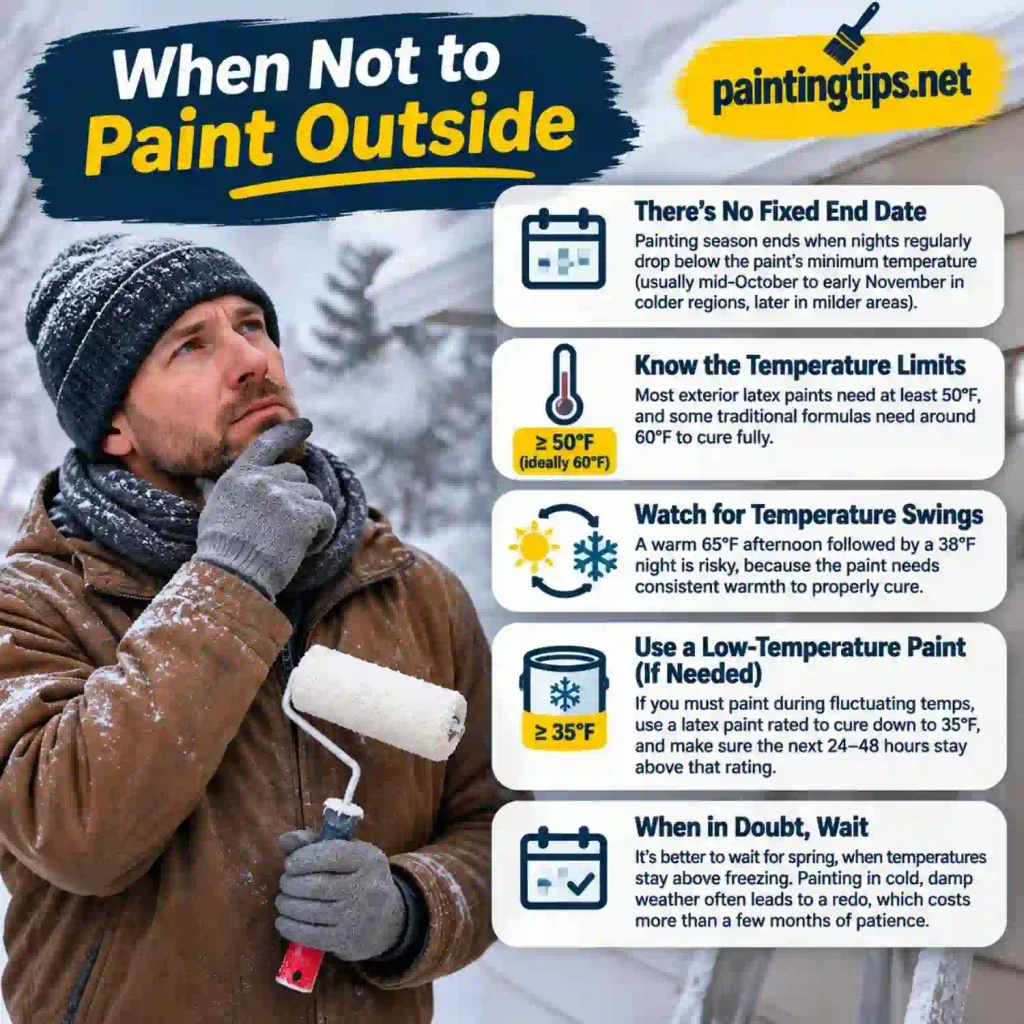
The biggest trap is the spring and fall swing season. Most standard exterior latex paints want at least 50°F, and some traditional formulas need closer to 60°F to cure fully, because those latex particles need warmth to fuse together. That is why a sunny 65°F afternoon followed by a 38°F night is so risky, even though the temperature looked fine at the time of application.
If you have to paint outside when temperatures are bouncing up and down, the safest move is a low-temperature latex made for it, one that is rated to cure down to 35°F. We list some solid options further down, in the section on paints for low temperatures. Just keep in mind that a minimum rating only works when the whole 24 to 48 hour window stays above it.
If the season gets away from you, there is no shame in waiting. An exterior job started in cold, damp weather often ends up being repainted, and that costs far more than a few months of patience. Book the work for spring, when temperatures stay above freezing on a regular basis, and you will get a longer-lasting finish.
How to Paint Outside When It’s Cold?
Start with a cold-rated exterior paint and a forecast that stays above its minimum for several days in a row. Everything else is about protecting that paint while it cures.
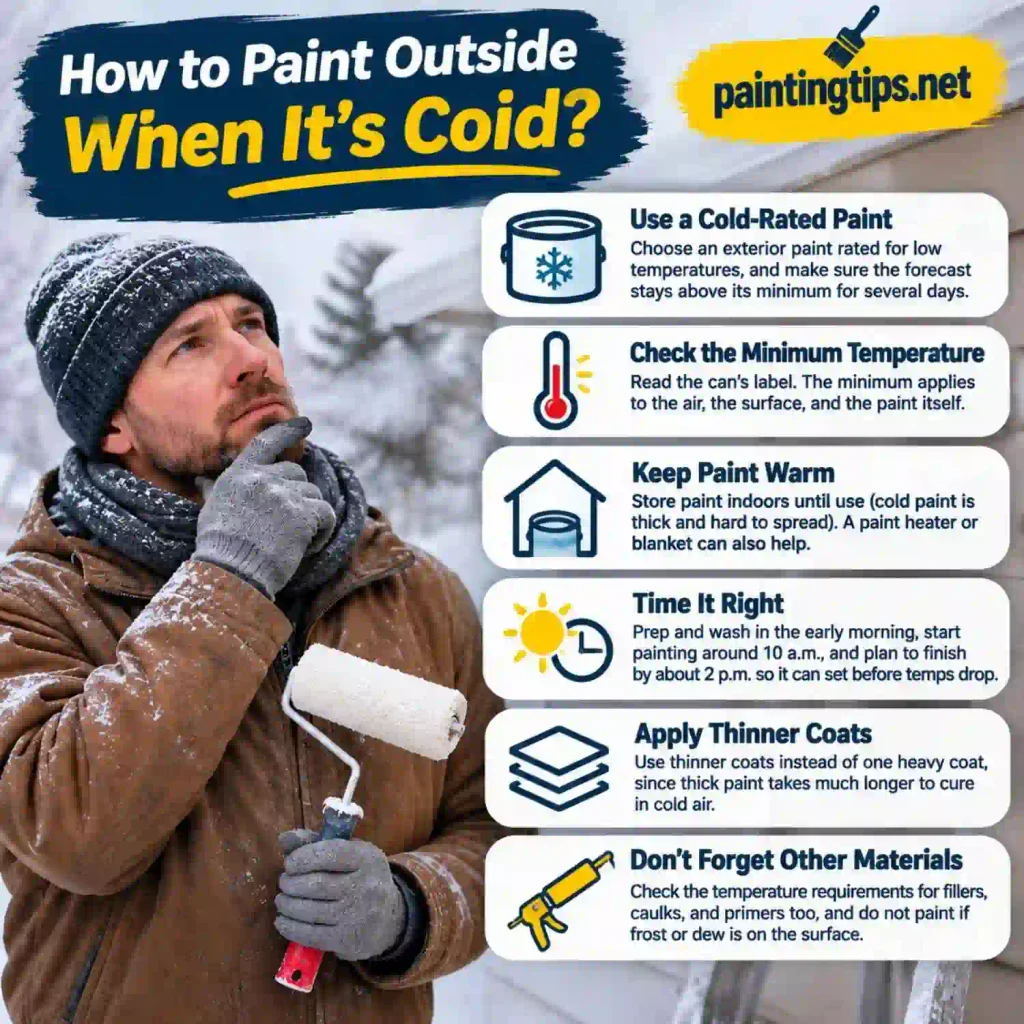
Check the back label of the can for the minimum application temperature, and remember that it applies to the air, the surface, and the paint itself. Store the paint indoors until you are ready to use it, since cold paint is thick and hard to spread, especially through a sprayer. A paint heater or blanket helps for the same reason. Prep and wash the exterior surfaces in the early morning so they can dry completely, and begin painting around 10 a.m. once the surface has warmed up. Plan to finish by about 2 p.m. so the paint has a chance to set before the temperature drops and dew forms.
Work in thinner coats rather than one heavy coat, because thick paint takes forever to cure in cold air. Check your fillers, caulks, and primers too, since some of them have higher minimum temperatures than the paint itself. And do not apply anything if frost or dew is on the surface.
At What Temperature Should You Not Paint Outside?
Stay off the ladder whenever the air or the surface is below 50°F with standard latex, below 40°F with oil-based paint, or below 35°F with any paint at all, and when it climbs above 85 to 90°F. Your can’s label always overrules a general rule, so check it first.
The surface deserves as much attention as the air. An exterior wall can be much colder than the thermometer on your porch, particularly on the shaded north side of the house, over masonry, and on metal siding and trim. It can also be wet with dew or frost you cannot see. A simple infrared thermometer tells you what you are really working with, and a good habit is to hold off if the surface is within about 5°F of the dew point.
Hot weather is just as damaging as cold, only in a different way. When it is too hot, the paint skins over before it can bond to the surface, and over 90°F you start to see bubbles and blisters that can peel later. Humidity matters at both ends. Painting outside when humidity is above 85 percent, or when rain is on the way, is asking for trouble, and the same goes for a night that is expected to dip under the label minimum within a day or two of application.
Is It Bad to Paint When It’s Cold Outside?
Not if you stay within the range on the label. Cold alone is not the enemy. The problem is cold that stops the paint from curing the way it was designed to.
When the temperature is in range, painting outside in cool weather can actually give good results, because the slower drying time lets the paint level out and leaves fewer brush marks. The trouble starts when the weather swings from comfortable days to freezing nights. That is when you get a film that looks fine on day one and fails by next season. A little planning goes a long way here, so keep an eye on the forecast for the days before and after you paint.
What Happens If You Paint and It’s Too Cold Out?
The paint never cures properly, and the damage usually shows up months later as cracking, peeling, and chipping. The first signs are often subtle, such as a dull or blotchy finish, but the weak film underneath is already there.
Because cold paint stays wet for longer, it also collects insects, dirt, and debris that get trapped in the film. Latex that never coalesces properly can stay soft and chalky, and moisture from dew or frost can leave stains or white and brown streaks that run down the wall. This is called surfactant leaching. Oil-based paint goes on stiff and heavy in the cold, so you use more paint for less coverage. In the worst case, you wash it off and start again, and that is a painful way to find out the temperature was just a few degrees too low.
What Is the Maximum Temperature to Paint Outside?
Somewhere between 85°F and 90°F is the ceiling for most exterior paints, with 90°F being the number you will see most often on labels. Above that, the paint dries too quickly and does not bond well with the surface.
The air temperature is only part of the story, since exterior surfaces in direct sun can be much hotter than the air around them. Dark siding and metal are the worst offenders. It is smart to follow the shade around the house, painting each wall after the sun has passed it, rather than painting in direct sunlight. You will get a more even finish and avoid lap marks, blisters, and brush strokes that dry before you can smooth them out. Check the can for the exact maximum, because it varies from paint to paint.
How Long Does Exterior Paint Take to Dry Before Rain?
Plan on roughly one to four hours for most modern acrylic latex exterior paints to become rain-resistant under good conditions, meaning warm air and moderate humidity. Oil-based paints usually need much longer, often a full day or more.
Cold, damp weather stretches those numbers out a lot. A fresh coat that would shrug off a shower on a warm afternoon can streak or wash off if it rains at 45°F with high humidity. So never rely on the “dry to the touch” time alone, and give the paint extra time if it is cool or humid. Check the can for the rain-ready time and look at the forecast for the full day before you start. If you want to know more about what rain does to fresh paint, we explain it in our post on whether can you paint in the rain is ever a good idea.
What Kind of Exterior Paint Is Suitable for Low Temperatures?
Low-temperature acrylic latex is built for exactly this situation. It is formulated to cure at temperatures as low as 35°F, and it contains coalescing agents that help the film form in the cold, which standard latex paints cannot do.
Sherwin-Williams Duration, Resilience, and SuperPaint and the Behr Marquee, Ultra, Premium Plus, and Pro e600 lines are all rated down to 35°F, while Benjamin Moore Aura Exterior is rated down to 40°F. Oil-based paint is the other common option in cool weather, with a minimum around 40°F, but it thickens in the cold and is harder to work with. If you are unsure which type fits your project, take a look at our comparison of oil based or water based paint before you buy. And if you are still choosing a product, our list of the best outdoor house paints is a good place to start.
At What Temperature Is It Okay to Paint Outside?
The comfortable range for painting outside is 50°F to 85°F for both the air and the surface, with moderate humidity and no rain in the forecast for at least a day, and 90°F is the hard ceiling. That is where you will get the most predictable results. If you are using a traditional latex that calls for closer to 60°F, keep to the warmer end of that range.
Low-temperature latex paints extend the range down to 35°F. Within those ranges, the best time of day is usually late morning to early afternoon, after the dew has dried and before the evening cool-down. Aim for humidity between 40 and 70 percent and a calm day, since strong wind dries paint unevenly and carries dust onto the wet surface.
Is October Too Late to Paint Outside?
Early October is usually safe in most regions, but by late October the nights in the northern half of the country often drop below what most paints can handle. So October is not too late everywhere, only in the colder regions and only as the month goes on.
For exterior work, the best conditions are usually in the summer months, when you can follow the shade around the house and paint each wall once the sun has moved off it. October is a workable alternative rather than the ideal time, and the answer depends on where you live and what the forecast looks like in the days around your project. In the South and the milder coastal regions, October can be a suitable time to paint, with moderate temperatures and nights that stay above most paint minimums.
In the northern states, nighttime lows can drop below 40°F after mid-October, and the days get shorter and damper, so the paint has less time to dry before the evening chill. If you are painting outside in October, look at the overnight lows as closely as the daytime highs, and plan to wrap up by early afternoon. A cold-rated paint can get you through a few chilly nights as long as they stay above the label minimum, but once freezing nights become regular, it is better to wait for spring.
If you are planning to do the job yourself, our guide on how to paint a house exterior yourself? covers the whole process from prep to the final coat. And if you are still deciding on a color, our article on what color should i paint my house? is a good use of the waiting time.
